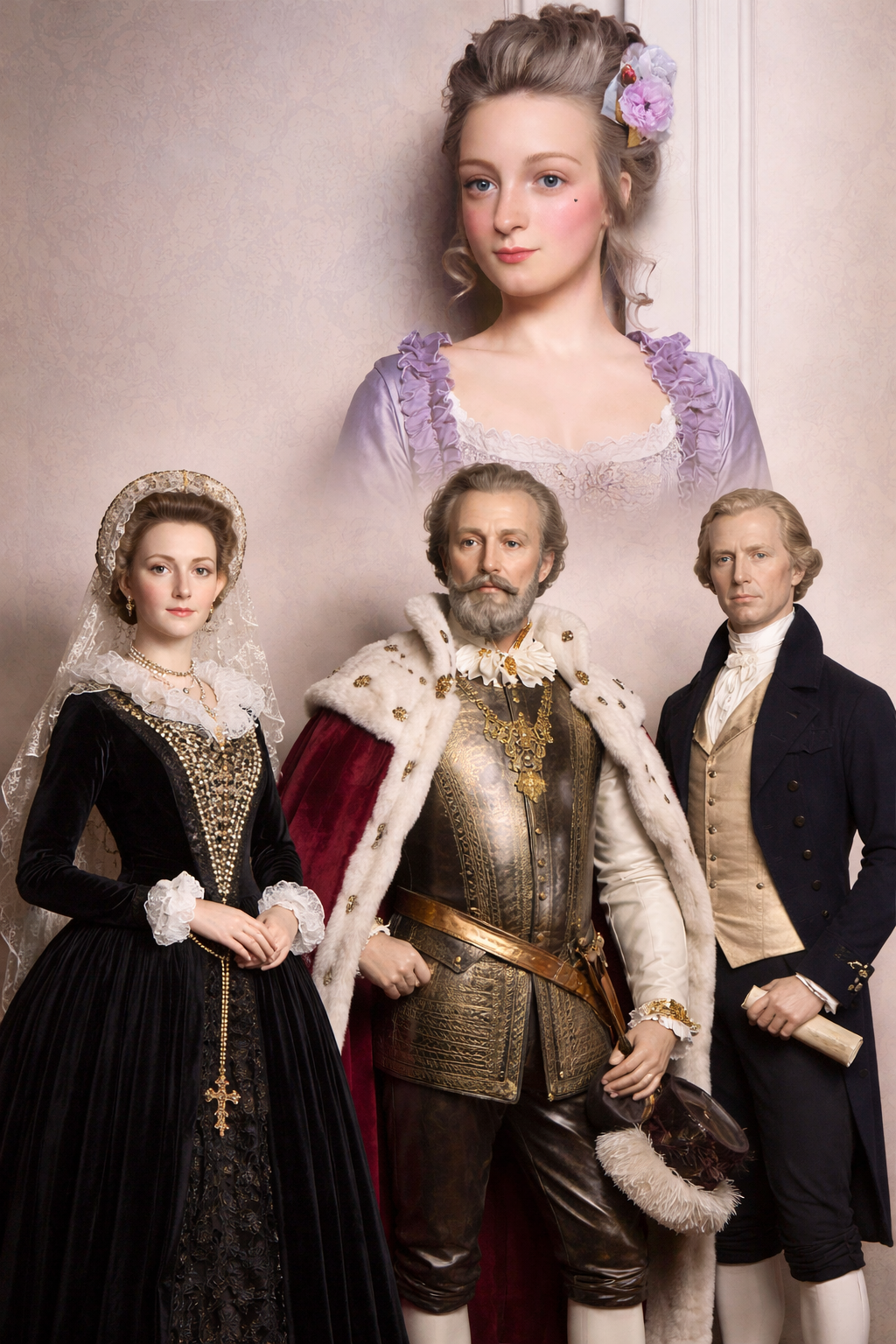
The Madame Tussaud You Don’t Know
Most people hear the name Madame Tussaud and think of celebrity selfies, velvet ropes, and flashing cameras. But the woman behind the world-famous museum lived a life far stranger, darker, and more impressive than her modern reputation suggests. Before her name became a brand, Marie Tussaud was a highly trained craftswoman whose work sat at the crossroads of science, politics, and survival.
It Wasn’t “Madame Tussaud’s” at First
The exhibition that eventually became Madame Tussaud’s began under a different name entirely: Curtius’ Curiosity. Philippe Curtius—Marie’s mentor—was a Swiss physician with a side interest in anatomy. Wax, at the time, wasn’t novelty material; it was used for medical teaching. Curtius created wax anatomical models to study the human body when cadavers were difficult to obtain. Portraits came later, almost as a natural extension of the same skill set. Marie didn’t learn wax modeling as an artistic hobby. She learned it as a precision trade.
When Curtius opened his exhibition in Paris, it was part cabinet of curiosities, part educational display. Portraits of philosophers and political figures were shown alongside anatomical studies. The goal wasn’t spectacle—it was accuracy. When Curtius died, he left the entire collection to Marie. That inheritance alone was extraordinary for a woman of the era.
She Didn’t “Sculpt”—She Studied
One of the least discussed aspects of Madame Tussaud’s process is how intensely observational it was. She preferred working from life, often sitting silently with her subject for extended periods. She watched how a person’s face settled when they weren’t performing for an artist. She paid attention to asymmetry, habitual expressions, and the way emotion subtly altered posture. Sketching, for her, was secondary. Memory and observation mattered more. She believed likeness wasn’t enough. The figure had to feel present.
Wax Was the Easy Part
The wax itself was only one component of her work—and not even the most difficult. Marie adjusted her wax formulas depending on climate, using different blends of beeswax, resins, and oils to prevent cracking or sagging. This became critically important when she later transported her collection across borders and climates. Hair was often real and inserted strand by strand. Eyes were glass, carefully selected for how they caught light. Coloring was built up in layers, mimicking the translucence of skin rather than sitting on the surface. This was slow, painstaking work. A single head could take weeks.
The Revolution Changed Everything
During the French Revolution, Madame Tussaud’s skills took on a far more dangerous role. She was compelled to create death masks—wax impressions taken from executed individuals. These were not artistic choices, but political demands. Refusal was not an option. Those grim commissions forced her to refine techniques that captured facial structure with brutal accuracy. Ironically, the most harrowing period of her life also sharpened the very skills that later made her exhibition successful. It’s worth noting: she survived the Revolution not because she was powerful, but because she was useful.
Britain Was a Gamble
When Madame Tussaud arrived in Britain, she didn’t immediately open a permanent museum. For years, she toured—transporting fragile wax figures through rough roads and unpredictable weather, displaying them in rented halls and assembly rooms. Early British audiences encountered something closer to Curtius’ original vision: figures presented with written historical context, not theatrical staging. Sensationalism came later—and reluctantly. Madame Tussaud resisted exaggeration. She believed distortion cheapened the work. Accuracy, she insisted, was what unsettled viewers most.
Why She Still Matters
Madame Tussaud wasn’t chasing fame. She was preserving faces in an era before photography made memory easy. Her work functioned as documentation, witness, and sometimes propaganda—but always with extraordinary technical skill. What began as Curtius’ Curiosity evolved into something far more lasting because Marie Tussaud understood a simple truth: People are drawn not to illusion—but to recognition.
And perhaps that’s why her story fits so naturally into the world of A Convenient Coincidence. Wax remembers what history prefers to smooth over. Faces remain, even when the truth behind them is less convenient.