Blackbeard’s Best-Kept Secret
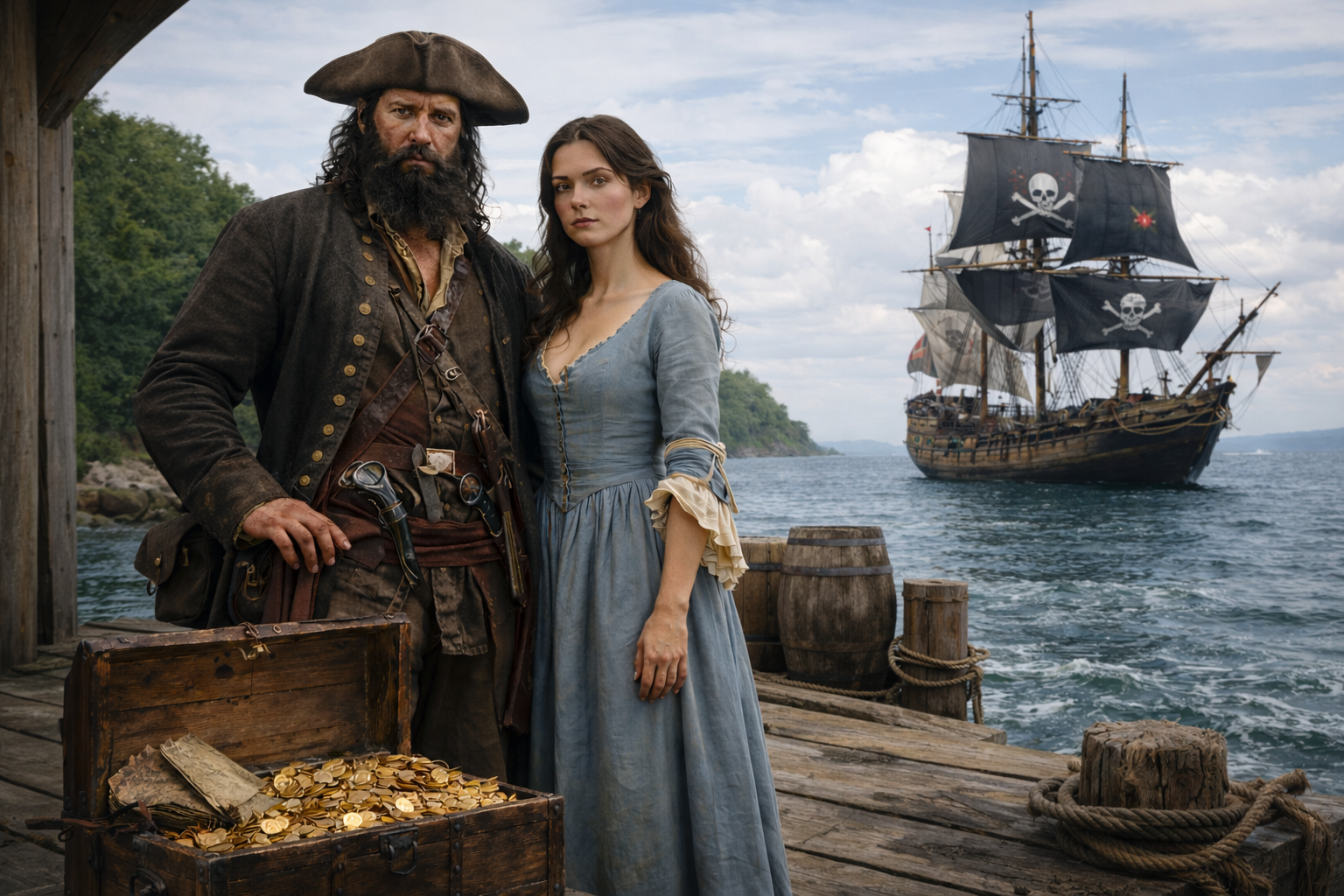
Blackbeard: What History Knows—and What My Story Wonders About
When most of us picture Blackbeard, we see smoke curling through his beard, pistols slung across his chest, and a ship bearing down on the horizon. He looms larger than life, half man and half warning. History gave us that version for a reason—Edward Teach wanted to be remembered that way.
But history, as it often does, leaves a few quiet spaces around the edges.
Those are the places stories like mine like to linger.
So let’s talk, plainly and comfortably, about what we know, what we suspect, and where imagination steps in and pulls up a chair.
What History Actually Tells Us:
Blackbeard was very real. He sailed during the Golden Age of Piracy, commanded the fearsome Queen Anne’s Revenge, and understood reputation as well as any general understood artillery. He used terror deliberately, theatrically—and often without needing to spill blood.
And yes, there is a small but genuine historical note that tends to surprise people:
Shortly before his death in 1718, Blackbeard is believed to have married.
The record is spare. No love letters. No diary. Just a mention, tucked into local accounts, easily overlooked. History shrugs and moves on.
But it’s hard not to pause there.
The Question History Doesn’t Answer:
Why would a man who lived outside the law bother with marriage at all?
That question sat with me longer than any battle or ship description ever did. Pirates expected short lives. They didn’t plan for old age. They didn’t tend toward roots.
Unless—just possibly—Blackbeard had already planned what would come after him.
Where My Story Takes a Gentle Step Sideways:
In my book, I imagine that marriage was not impulsive or symbolic, but purposeful—and quietly guarded.
Not romance in the modern sense, perhaps, but trust. Continuity. Someone who could outlive the legend.
From there, the idea follows naturally:
If Blackbeard knew his end would be violent—and most pirates did—he would never leave his fortune to chance. Or to a single map that could be stolen, copied, or destroyed.
So instead of burying treasure and hoping for luck, my Blackbeard does what he always did best.
He plans.
Why England Makes Sense:
Popular lore insists pirate treasure belongs under palm trees and shifting sands. It’s a lovely image—but England offers something far more useful: permanence.
In the novel, Blackbeard leaves a trail of clues scattered across England itself. Not obvious markers. Not Xs on maps. But fragments tucked into records, places, and patterns that only someone looking the right way would ever notice.
England was familiar to him. Ordered. Predictable. Safe in its assumptions.
No one expects a pirate’s legacy to hide there.
That, of course, makes it perfect.
Clues Instead of Confessions:
Rather than a single dramatic revelation, the trail unfolds slowly:
A repeated phrase in church records
An odd alignment of coastal landmarks
A name that appears just often enough to matter
A choice that seems meaningless—until it isn’t
Each piece alone feels harmless. Together, they tell a story.
Not of gold alone, but of foresight.
Legend as the Best Disguise:
Here’s the part where history and fiction shake hands.
The real Blackbeard understood misdirection better than anyone afloat. He made himself monstrous so no one would look for subtlety. The louder the legend grew, the safer the truth became.
In my story, that legend does its final, finest work—keeping his real intentions buried in plain sight.
A Few Friendly Truths to End On:
There is no historical proof of a treasure trail across England
There is no record of a long-hidden marital conspiracy
There is a documented marriage
There is a man known for planning three moves ahead
And sometimes, that’s all a storyteller needs.
History gives us the bones.
Imagination gives them a heartbeat.
And Blackbeard—whether man, myth, or something in between—still knows how to keep a secret.