HEU: What Science Says — and Where Fiction Steps Back
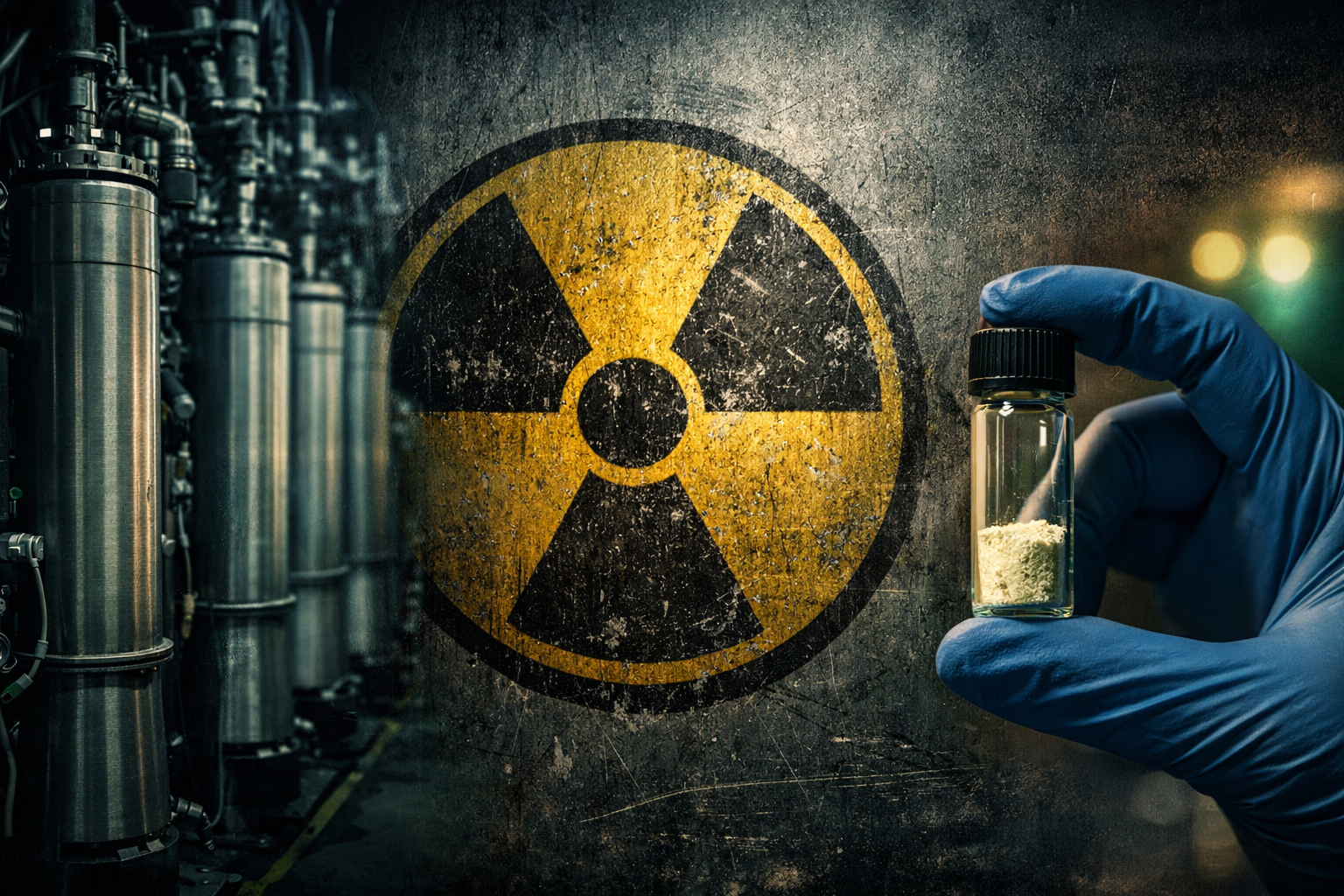
The most dangerous failures aren’t the ones caused by broken machines. They’re caused by systems doing exactly what they were designed to do — and nothing more.
That realization sits at the heart of how highly enriched uranium, often shortened to HEU, moves through the real world. It’s also what drew me to the subject while writing Mind’s Eye.
HEU isn’t frightening because it behaves unpredictably. It’s frightening because it behaves precisely as expected — quietly, incrementally, and without announcing when it has crossed from benign to catastrophic.
This post isn’t a technical manual, and it isn’t meant to be. Instead, it’s a look at three things side by side: what open science tells us about HEU and the extraction of U-235, what my novel assumes based on that science, and where I intentionally stepped away from reality to keep the story plausible without ever becoming instructional.
What Highly Enriched Uranium Actually Is:
Uranium occurs naturally, but not all uranium behaves the same way. Most of it exists as U-238, a heavier and more stable form. A much smaller fraction — less than one percent — is U-235, the isotope capable of sustaining a chain reaction under the right conditions.
Highly enriched uranium isn’t a different substance. Nothing is added. Nothing is “activated.” The material doesn’t change its appearance or announce its danger. The only thing that changes is the ratio. That subtle shift — increasing the proportion of U-235 — is enough to alter uranium’s potential entirely.
**What Science Publicly Says About Extracting U-235:
(And What It Quietly Emphasizes)**
One of the most counterintuitive aspects of uranium enrichment is that understanding the physics is not the hard part.
The underlying principle — that U-235 is very slightly lighter than U-238 — has been understood for decades. What limits enrichment in the real world isn’t theory, but engineering discipline. Public scientific literature repeatedly stresses that enrichment is constrained by bottlenecks: extreme precision, consistency over time, and the ability to maintain stable conditions without interruption. This is why enrichment doesn’t lend itself to shortcuts. It isn’t something a single brilliant mind can accomplish in isolation. It requires infrastructure, patience, and control — sustained effort rather than sudden insight. The danger lies not in ingenuity, but in persistence.
Another point science makes clear, though it’s often overlooked in popular discussions, is that enrichment is not an energetic or dramatic process. It doesn’t involve surges or spikes. It depends on steady input, repeatability, and uniformity. Disruption is the enemy of success. Precision matters more than speed. That quiet, industrial character is part of what makes enrichment so easy to misunderstand — and so difficult to detect.
Detection systems, after all, are not designed to “find enrichment.” They are designed to identify specific signatures, byproducts, or deviations from expected behavior. Much of nuclear oversight relies on accounting, pattern recognition, and assumptions about what should be happening inside a facility.
Science openly acknowledges this limitation. Sensors don’t search for intent. They search for what they’ve been trained to recognize. If something behaves within expected parameters — even if it is trending somewhere dangerous — it may never register as a problem at all.
Perhaps the most unsettling scientific truth is this: there is no natural warning threshold built into enrichment. Physics doesn’t announce when uranium becomes dangerous. Risk increases continuously, but regulatory labels change discretely. The lines that matter most — “safe,” “concerning,” “unacceptable” — are human inventions. Nature doesn’t care where those lines are drawn.
Which means danger doesn’t arrive at a moment. It accumulates — quietly — while systems wait for a signal that may never come.
What Mind’s Eye Assumes — and Why That’s Plausible:
In Mind’s Eye, I don’t walk readers through machinery or methods. Instead, the story assumes what science already accepts: that the physics are settled, the process is incremental, and the real vulnerability lies not in discovery, but in oversight and expectation.
The novel hinges on systems calibrated to detect what they expect to see — and nothing else. That isn’t speculative science. It’s how complex systems operate in the real world, whether they’re monitoring radiation, financial risk, or air traffic.
From that perspective, the scenario in the book is plausible not because the science is extraordinary, but because it isn’t.
Where Fiction Deliberately Steps Back:
This is the line I was careful not to cross.
While the novel is grounded in real physics, it deliberately avoids anything that would turn principle into procedure. There are no descriptions of machinery design, no efficiencies, no timelines, no thresholds, and no technical instructions of any kind.
Real enrichment programs require enormous industrial precision, specialized engineering, and years of tightly controlled effort. Fiction compresses and abstracts those realities — not to oversimplify them, but to avoid turning narrative into reference material.
That choice wasn’t about convenience. It was about responsibility.
Good fiction can explore consequences without explaining construction. It can ask what if without answering how.
The Quiet Truth Beneath the Science:
What stayed with me most after researching highly enriched uranium wasn’t the complexity of the process. It was how silent it is. No spectacle. No obvious warning.
No moment when danger declares itself.
That silence is what science discusses carefully — and what fiction is uniquely positioned to explore.
And it’s exactly where the line should be.